Why Choose Stainless Steel Buttons for Your Products?
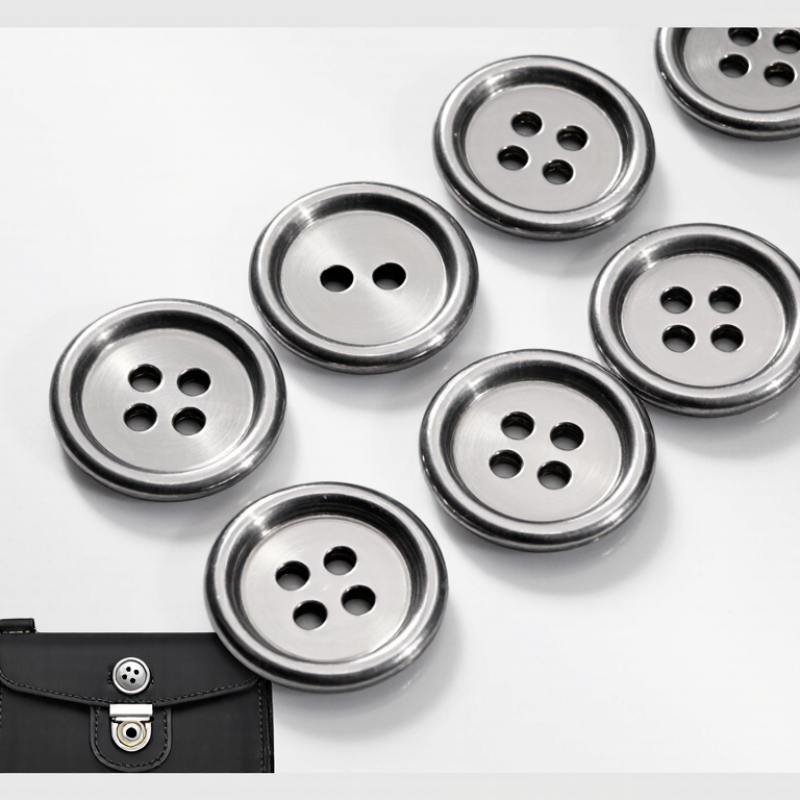
When product details face daily handling, small components can influence the entire customer experience. Stainless Steel Buttons offer a practical balance of strength, appearance, and long-term usability. They suit jackets, uniforms, bags, footwear, and selected home textile products. Their clean metallic surface can make a simple design feel more refined.
The details matter.
In real production, button performance depends on more than material choice. The alloy grade, surface treatment, button thickness, attachment method, and quality inspection all deserve attention. A well-made button should resist ordinary moisture, repeated pressing, and surface abrasion during normal use. However, stainless steel is not flawless. Poor finishing may create sharp edges, uneven color, or uncomfortable contact against fabric. That weakness should be acknowledged before large-scale production.
Experienced manufacturers usually test samples on the intended product, rather than judging buttons separately. They check attachment strength, surface consistency, dimensional accuracy, and performance after repeated handling. For a children’s garment, safety and secure attachment require especially careful review. For workwear, practical durability may matter more than decorative shine. Product designers should also consider weight, washing conditions, packaging, and the final user’s expectations.
Stainless Steel Buttons can support a dependable product image, but they cannot repair weak design decisions. Requesting material details, finish samples, and inspection records helps buyers make informed choices. A thoughtful selection process reduces replacement costs and protects brand credibility. Sometimes, the most attractive option is not the most suitable one. Practical testing reveals that difference.
Stainless Steel Defined: ≥10.5% Chromium Under ISO 15510
Why Choose Stainless Steel Buttons for Your Products?
Under ISO 15510, stainless steel grades contain at least 10.5% chromium by mass. Chromium forms a thin, self-healing oxide layer on the surface. This layer helps resist rust, stains, and daily handling. It is invisible, but valuable.
The International Stainless Steel Forum reported 58.4 million tonnes of crude stainless steel production in 2023. That volume reflects continued demand across construction, appliances, transport, and consumer products. Buttons benefit from the same material properties. They can withstand repeated pressing, abrasion, moisture, and frequent cleaning. In practical quality checks, a well-finished button should feel smooth around its rim. Sharp edges often reveal weak forming or inadequate polishing.
Still, chromium content alone does not guarantee performance. Grade selection matters. Nickel can improve structure and formability, while molybdenum may support resistance in saltier environments. A button used on outdoor clothing faces different conditions from one used on a handbag. ISO 15510 helps identify composition, but designers must also review hardness, finish, fastener compatibility, and corrosion test results. A reflective surface can hide small scratches. That deserves a closer inspection. According to the U.S. Geological Survey’s Mineral Commodity Summaries, chromium remains an essential alloying material for stainless steel production, linking raw-material quality to long-term product reliability.
Grade Selection: 304 Has ~18% Chromium/8% Nickel; 316 Adds 2–3% Molybdenum
Why Choose Stainless Steel Buttons for Your Products?
A button looks small, yet its alloy controls durability, appearance, and maintenance. Grade 304 contains about 18% chromium and 8% nickel. These figures match the familiar 18-8 stainless classification and ASTM A240 composition ranges. Chromium creates a passive surface film. Nickel improves ductility and corrosion resistance. For clothing, bags, and light hardware, 304 often balances finish, strength, and cost. The USGS 2024 Mineral Commodity Summaries identifies stainless and heat-resistant steel as consuming roughly 65% of primary nickel demand. Material pricing therefore deserves attention.
Grade 316 adds approximately 2–3% molybdenum, with commonly higher nickel content. Molybdenum improves resistance to pitting caused by chlorides, perspiration, seawater mist, and de-icing salt. Technical guidance from the Nickel Institute links molybdenum-bearing grades with better chloride performance. On a damp jacket, this may mean fewer tea-colored spots near scratches. Small detail, visible consequence.
Still, 316 is not automatically better. It costs more, while poor forming or polishing can reduce its advantage. I would test both grades. Use artificial perspiration, salt spray, rubbing, and laundering. ASTM B117 standardizes salt-spray exposure, but it cannot represent every garment environment. Test the finish. A well-finished 304 button may outperform poorly processed 316. The grade label is useful, but it is not the whole product.
Why Choose Stainless Steel Buttons for Your Products?
Grade selection affects corrosion resistance and material performance. Stainless steel 304 typically contains about 18% chromium and 8% nickel, while 316 adds approximately 2–3% molybdenum for improved resistance in chloride-rich environments.
Note: The values shown are representative midpoint compositions based on commonly specified ranges. Actual composition may vary by applicable material standard and product specification.
Corrosion Resistance: Apply ISO 9227 Salt-Spray Testing to Compare Button Grades
Why Choose Stainless Steel Buttons for Your Products?
Corrosion resistance is not a marketing assumption. It needs controlled evidence. ISO 9227:2022 defines neutral salt-spray testing with a 5% sodium chloride solution at 35°C. The chamber exposes buttons to a steady, aggressive salt mist. This can reveal staining, pitting, and coating failure quickly. However, ISO 9227 does not set universal acceptance hours. That decision belongs to the product specification.
Compare 304, 316, and 430 stainless steel buttons under identical conditions. Grade chemistry matters. Molybdenum in 316 generally improves chloride resistance, while 430 often needs more cautious placement. Test identical dimensions, edge conditions, surface finishes, and production lots. Record exposure hours, first visible corrosion, pit density, and functional changes. A 240-hour result is not a 240-hour field guarantee. That distinction is easy to miss.
The NACE IMPACT study estimated global corrosion costs at US$2.5 trillion annually, or 3.4% of global GDP. The figure covers all industries, not buttons alone. Still, it shows why small components deserve disciplined testing. In practice, I would photograph each button beside a reference scale. I would also repeat questionable results. Salt spray can exaggerate some environments and underrepresent others. That is the uncomfortable part. Product teams should combine ISO 9227 data with humidity, sweat, cleaning, and outdoor exposure tests.
Why Choose Stainless Steel Buttons for Your Products? - Corrosion Resistance: Apply ISO 9227 Salt-Spray Testing to Compare Button Grades | Stainless Steel Grade | Typical Chemical Composition | Magnetism | Relative Salt-Spray Resistance | Suitable Button Applications |
| AISI 304 / EN 1.4301 | Cr: 17.5–19.5%; Ni: 8.0–10.5%; Mo: typically not added | Generally non-magnetic when annealed; may become slightly magnetic after cold working | Good in normal indoor and mild outdoor environments | General apparel, bags, footwear, accessories, and consumer products |
| AISI 316 / EN 1.4401 | Cr: 16.5–18.5%; Ni: 10.0–13.0%; Mo: 2.0–2.5% | Generally non-magnetic when annealed; may become slightly magnetic after cold working | Very good in chloride-rich, coastal, and humid environments | Premium buttons, marine-related products, swimwear accessories, and high-humidity applications |
| AISI 430 / EN 1.4016 | Cr: 16.0–18.0%; Ni: typically not intentionally added; Mo: not added | Magnetic | Moderate in dry indoor environments; less resistant to chloride exposure | Cost-sensitive indoor products, decorative components, and applications requiring magnetism |
| ISO 9227 Test Item | Recommended Specification | Purpose for Stainless Steel Buttons |
| Test method | ISO 9227:2022, Neutral Salt Spray (NSS) | Provides a controlled comparative environment for evaluating corrosion behavior |
| Salt solution | Approximately 5% sodium chloride solution prepared with suitable water quality | Simulates an aggressive chloride-containing atmosphere |
| Chamber temperature | 35 ± 2 °C | Maintains consistent test conditions between button grades |
| Collected spray rate | 1.0–2.0 mL per hour for a 80 cm² collection area | Confirms that the corrosive spray environment is operating within the standard range |
| Solution pH | 6.5–7.2 at 25 ± 2 °C | Prevents abnormal acidity or alkalinity from distorting the comparison |
| Suggested exposure intervals | 24, 48, 96, and 168 hours, or another period defined by the product specification | Shows the progression from early staining to more visible corrosion during development testing |
| Evaluation criteria | Record red rust, pits, blistering, coating damage, tarnish, and functional changes using photographs and a defined rating scale | Enables an objective comparison without assuming that ISO 9227 itself defines a universal pass/fail exposure time |
Testing note: ISO 9227 specifies the salt-spray apparatus, operating conditions, and test procedure, but it does not establish a universal corrosion-resistance rating or pass/fail duration for every product. Exposure time and acceptance limits should therefore be agreed according to the button material, finish, intended environment, and product specification.