
ZenaDrone Homepage

How to Choose China Top Solar Power System For RV?

Choosing a Solar Power System For Rv requires more than comparing panel wattage or online prices. An RV roof is a moving, shaded, and space-limited energy site. Air conditioners, refrigerators, water pumps, laptops, and induction cookers can create very different daily loads. A 200-watt array may support lights and charging, but it may disappoint when clouds cover the campsite.

Industry data shows why system quality matters. The International Energy Agency’s Renewables 2024 report expects global renewable capacity to expand by about 5,500 gigawatts between 2024 and 2030, with solar PV and wind providing most additions. This rapid growth has improved component availability, especially for Chinese manufacturers. However, scale does not guarantee suitability. NREL’s PVWatts guidance emphasizes irradiance, temperature, orientation, shading, and system losses when estimating solar output. Real roofs rarely match laboratory conditions.

A reliable China-made RV system should therefore be judged through evidence, not promotional claims. Check panel efficiency, MPPT controller performance, battery cycle data, inverter waveform, connector quality, and relevant safety certifications. Ask for test reports, warranty terms, factory traceability, and clear after-sales support. LiFePO4 batteries can reduce weight and provide stable storage, but their protection system and low-temperature charging control deserve close attention. Cable size matters too. Thin cables can quietly waste energy and create heat.

The best design begins with measured consumption. Record appliances for several days. Leave reserve capacity for poor weather. A larger panel is not always better. That assumption needs challenging. Careful sizing, verified components, and realistic expectations make an RV solar system safer, quieter, and more dependable on the road.
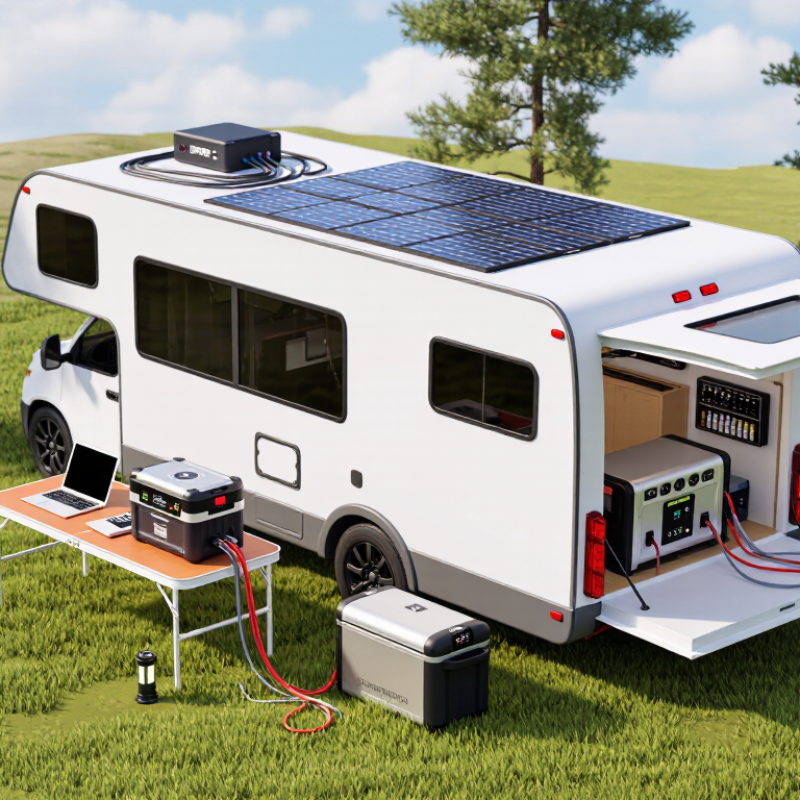
How to Choose China Top Solar Power System For RV?

Define Your RV’s Solar Energy Needs and Travel Habits

Before choosing a solar power system for an RV, measure how you actually use electricity. List every device used during a normal travel day. Include a compressor refrigerator, lights, water pump, ventilation fan, laptop, and phone chargers. Record each device’s wattage and operating hours. A 60-watt laptop running for three hours consumes about 180 watt-hours. A refrigerator cycles, so its label rating is not its daily consumption. Track it over two or three days.

Your habits matter more than a generous sales estimate. If you camp in shaded forests, expect less solar harvest. Cloudy weather can reduce output sharply.

Consider your travel pattern before selecting panel capacity and battery storage. Weekend travelers may need less storage than people staying off-grid for a week. Estimate daily energy, then add a practical reserve of 20 to 30 percent. This buffer covers cool mornings, dirty panels, and unexpected device use.

For example, 800 watt-hours per day may require roughly 1,000 watt-hours of usable storage.

Panel size should match sunlight, roof space, controller limits, and battery chemistry.

Do not fill the roof without checking shadows from air conditioners or roof racks. Do not guess. I once overestimated winter production because I used summer sunlight data. That mistake meant rationing laptop time on a rainy trip. It was inconvenient.

Use local solar data and technical specifications from reputable manufacturers. Also confirm wiring, fuses, ventilation, and installation requirements with a qualified technician.

Compare Solar Panel Types for Different RV Roofs and Setups

Choosing a solar power system for an RV starts with the roof, not the panel wattage. Rigid monocrystalline panels usually deliver strong output in limited space. They suit flat, sturdy roofs with enough clearance for mounting hardware. Their glass surfaces resist weather well, but they add weight and increase wind exposure. Measure roof curves, vents, air conditioners, and walking space before choosing them.

Flexible panels work better on slightly curved roofs and low-clearance setups. They are lighter and easier to install. However, heat can reduce their performance when air cannot circulate underneath. Portable folding panels offer useful freedom for shaded campsites. You can place them in direct sunlight while parking the RV under trees. That convenience requires storage space and regular repositioning. My early mistake was judging panels by rated watts alone. Real output also depends on temperature, shading, cable length, and controller quality.

Tips: Check the roof’s load capacity first. Leave space around vents and allow safe cable routing. Use a charge controller suited to the battery type. For partial shade, separate panels into suitable circuits when possible. Test midday output with a meter, not only an app. Small details matter. A practical setup may use rigid panels on the main roof, plus a portable unit for shaded stops. Inspect seals after installation, because one neglected screw hole can create expensive moisture damage.

How to Choose a Solar Power System for an RV

Rigid monocrystalline panels usually provide the highest power density and are a strong choice for flat, load-bearing RV roofs. Semi-flexible and CIGS flexible panels are lighter and better suited to curved or weight-sensitive roofs, but generally produce less power per square metre. Folding portable panels are useful when the roof is shaded, crowded, or unsuitable for permanent installation.

The chart shows typical power-density ranges for commonly used RV solar panel types. Actual performance varies with cell efficiency, temperature, shading, installation angle, and controller losses.

Choose the Right Battery, Inverter, and Charge Controller

Choosing a solar power system for an RV starts with the battery, not the solar panel. List each appliance, its wattage, and daily running time. A 12V refrigerator, lights, ventilation fan, and device chargers can consume more energy than expected. Add a 20–30% reserve for cloudy weather and battery aging. Lithium batteries offer lower weight and more usable capacity, but cold-temperature charging needs protection. Lead-acid batteries cost less, yet they require more space and careful discharge limits. Ask for cycle-test data, cell-balancing details, thermal protection, and clear safety documentation.

The inverter should match your real appliances. Choose a pure sine wave model for sensitive electronics and motor-driven equipment. Its continuous output should exceed your expected load by about 20–30%. Refrigerators and pumps may need a short surge when starting. Check this rating carefully. It is easy to select a unit that works on paper but trips beside a campsite.

The charge controller must match the battery voltage and solar array voltage. MPPT controllers usually harvest more energy during cool mornings or weak sunlight. Confirm maximum input voltage, charging current, and temperature compensation. Keep cables short and properly sized to reduce heat and voltage loss. I once underestimated startup power and had to revise the system. Real measurements beat assumptions. A simple battery monitor can reveal whether the system performs well after several cloudy days.

Evaluate China Solar Suppliers, Quality Standards, and Warranty Terms

How to Choose China Top Solar Power System For RV?

China’s solar manufacturing scale is significant. IRENA reported 216.9 GW of solar capacity additions in China during 2023. Scale helps pricing, but it does not guarantee RV suitability. Evaluate suppliers through factory audits, production records, and traceable component models. Request IEC 61215 and IEC 61730 test evidence for modules. These standards address module durability and electrical safety. A certificate alone is not proof.

Ask whether each panel passed flash testing, electroluminescence inspection, and insulation checks. For an RV, inspect junction-box sealing, connector compatibility, and resistance to vibration. NREL’s degradation analysis found a median photovoltaic degradation rate near 0.5% annually. Use this figure carefully. Actual results depend on heat, shading, installation, and maintenance. I would not trust a beautiful efficiency sheet without field data.

Warranty terms deserve equal attention. Many suppliers advertise ten to twelve years for product defects and up to twenty-five years for output performance. Confirm the exact output threshold, claim procedure, shipping responsibility, and labor coverage. Check exclusions for improper installation, salt exposure, water intrusion, and unauthorized repairs. Battery warranties should state cycle limits, usable capacity, temperature conditions, and battery-management requirements. Ask for serial-number tracking and a written response period. Small details matter. One uncomfortable question remains: who pays when the RV is far from the supplier?

How to Choose China Top Solar Power System For RV? - Evaluate China Solar Suppliers, Quality Standards, and Warranty Terms

Reference comparison for RV solar system sourcing. Specifications and warranty terms should be confirmed in the supplier’s quotation, datasheets, certificates, and warranty documents.
Evaluation Dimension Export-Ready Manufacturer OEM System Integrator Trading Supplier Recommended RV Buyer Check
Typical RV System Range 400–2,000 W solar array; 2–10 kWh battery storage 200–1,500 W solar array; 1–8 kWh battery storage Usually assembled to order; specifications vary by component source Match daily energy demand, roof area, battery capacity, and inverter load—not only panel wattage
Solar Module Technology Monocrystalline modules, commonly 19–23% module efficiency Monocrystalline rigid or flexible modules, commonly 18–23% efficiency Technology depends on the selected manufacturer and available stock Request module efficiency, temperature coefficient, dimensions, weight, and bypass-diode details
Battery Chemistry LiFePO₄ battery with integrated battery management system LiFePO₄ battery, often configurable for 12 V, 24 V, or 48 V systems May offer LiFePO₄ or lead-acid options; cell origin should be verified Confirm usable capacity, continuous current, low-temperature charging protection, and BMS communication
Solar Module Standards IEC 61215 and IEC 61730 certificates commonly available for export models Certificates normally supplied for the selected module model Certificate availability must be checked for each exact model Verify model numbers on certificates match the quotation and product labels
Battery Safety Documentation UN 38.3 transport test; IEC 62619 or equivalent industrial battery safety evidence may be available Usually available when using established battery suppliers Documentation quality varies significantly by source Request UN 38.3, MSDS/SDS, battery test reports, and applicable regional transport documents
Quality Management ISO 9001 quality-management certification is commonly expected May rely on audited component factories and documented incoming inspection Quality controls depend on subcontractors and purchasing procedures Ask for factory audit records, incoming inspection standards, final test reports, and serial-number traceability
Inverter and Charger Functions MPPT controller, pure-sine inverter, shore-power charger, and low-voltage protection commonly integrated Flexible configuration with separate or combined inverter-charger units Functions depend on the selected component models Check continuous and surge power, MPPT voltage range, idle consumption, waveform, and shore-power compatibility
Panel Product Warranty Common market range: 10–15 years for product workmanship Common market range: 10–12 years for product workmanship Terms vary by sourced module Confirm exclusions, claim process, labor coverage, and whether warranty is backed by the actual manufacturer
Panel Performance Warranty Common market range: 25–30 years with a defined degradation schedule Common market range: 25–30 years, depending on module type Must be verified from the original module warranty Look for first-year degradation, annual degradation rate, and minimum end-of-term output
LiFePO₄ Battery Warranty Common market range: 5–10 years or a specified cycle limit Common market range: 5–8 years, subject to operating conditions Terms may be shorter or dependent on the upstream battery supplier Check cycle count, depth of discharge, charging temperature, retained capacity, and replacement liability
Inverter Warranty Common market range: 3–5 years, with optional extensions Common market range: 2–5 years Depends on the selected inverter supplier Confirm whether replacement, repair, shipping, and technical support are included
Pre-Shipment Testing Electrical safety, insulation, charging, discharge, and functional tests are commonly documented System-level functional testing is commonly available as an added service Testing scope should be defined contractually Require a signed inspection checklist, photographs, serial numbers, and test results before shipment
Customization Capability High; mounting kits, cable lengths, connectors, displays, and software can often be configured Very high; suitable for private-label RV kits and vehicle-specific layouts Moderate; customization may be limited by component availability Obtain a complete bill of materials and confirm compatibility with the RV’s existing wiring
After-Sales Support Dedicated technical contact, replacement parts, and remote troubleshooting are commonly available Usually provides system integration support and installation guidance Support quality depends on the supplier’s service team and component sources Define response time, spare-parts policy, remote diagnostics, and escalation procedure in writing
Best Use Case Long-term ownership, repeat purchasing, and buyers prioritizing traceability Complete RV kits, OEM projects, and vehicle-specific installations Small trial orders or price-sensitive purchases requiring careful verification Select the supplier with the clearest documentation, compatible design, and enforceable warranty—not simply the lowest price

Plan Installation, Maintenance, and Future System Expansion

How to Choose China’s Top Solar Power System for an RV

Choosing a high-quality Chinese solar system for an RV requires more than comparing panel wattage. Measure the roof first, including vents, air conditioners, and shaded areas. A 400-watt system may suit weekend travel, while full-time users often need more capacity. Match the panels with a suitable charge controller, lithium battery, inverter, and correctly sized cables. Check test reports, protection ratings, warranty terms, and installation guidance. A certified electrician should verify the wiring, grounding, fuses, and battery ventilation.

Tips: Leave space for future panels. Use waterproof connectors. Label every cable.

Plan expansion before drilling. Install an inverter and controller that can handle additional capacity, but do not oversize the battery without checking charging limits. A spare roof conduit can prevent expensive rewiring later. Keep cable runs short and protect them from sharp metal edges. In my view, neat installation matters as much as power output. A messy system may work today and confuse everyone during a roadside repair.

Maintenance is simple but not optional. Inspect connectors every few months, clean dust from panels, and check battery readings before long trips. Watch for loose brackets, cracked sealant, or unusual heat around fuses. Cloudy weather can expose weak planning quickly. I would also record monthly energy production. The numbers may reveal a hidden shadow or a battery that is aging sooner than expected. Good documentation makes future upgrades safer.

Scroll to Top